Beautifully American
July 11th, 2025 by G.
https://x.com/InezFeltscher/status/1943744667675218301#m
https://x.com/InezFeltscher/status/1943744667675218301#m
Elder Cook told mission leaders that, from June 1, 2024, through May 31, 2025, convert baptisms were the highest of any 12-month period in Church history. Every region of the world saw at least a 20% increase in convert baptisms in the first quarter of 2025 compared with the same period in 2024.
https://newsroom.churchofjesuschrist.org/article/church-of-jesus-christ-record-global-growth
It feels like something in the air has shifted. Change is coming. I can feel it.
https://nitter.poast.org/eigenrobot/status/1941864747202117950#m
https://x.com/eigenrobot/status/1941864747202117950#m
eigenrobot
@eigenrobot
Jul 6
“science” used to be great because no one believed in it. but since empiricism is now globally and hopelessly corrupted by Belief and careerism, the only reliable ways to know anything are
1. having good aesthetics for theory
2. direct observation (gnosis)
3. divine revelation
This is another example of Goodhart’s law. When Data and Science and Experts become the widespread basis for making decisions they inevitable become corrupt. You might be better consulting entrails.
P.S. one reason why revelation also doesn’t always come quickly and immediately and clearly maybe so that we don’t start relying on automatically and then interspersing it with our own feelings about what we think ought to be done without realizing it
More on the parts of the D&C that everyone else is done talking about–
In sections (D&C 67-75) that are full of power–crowns, glory, immortality, eternal life, riches, lands, inheritance, generations–the part that hit me the most was three simple commandments. Teach your children, honor the Sabbath, remember your labors. 68:28-30. And a piece of advice: gird up your loins but be sober. 73:6.

Delving a little deeper, Isaiah 5 is about False Doctrine.
When we read Isaiah 5, we are prone to assume some very simplistic symbolism. But the Jews have a deeper symbolism that we have not always delved into. The Vineyard may be the Lord’s people, but what is wine? For the Jews, wine represents understanding or knowledge.
How does this illuminate the passage? This chapter starts off with the Parable of the Vineyard – a vineyard was planted but brings forth bad, perhaps even poisonous, grapes. So the Lord of the Vineyard will destroy it.
Thus, the vineyard is yielding corrupt understanding, or false doctrine.
But this is more interesting once you start looking at the Six Woes. At first, they appear to be six unrelated curses. But they all have a common theme, once you understand what wine is.
First: (5:8-10) Hording land -> hording vineyards: At the surface level, this doesn’t appear to have a connection to the parable, but what would this mean in terms of knowledge? Those who gatekeep knowledge, perhaps including schools.
Second: (5:11-12) Those who drink carelessly -> those who do not treat knowledge seriously. “they regard not the work of the Lord,”
Followed by two Therefores. Notice the theme is a lack of knowledge, that is equated with thirst and hunger.
Third: (5:18-19) Drawing vanity. -> In the context of knowledge, is this those who make rationalizations for sin?
Fourth: (5:20) Call evil good -> flat out falsehood
Fifth: (5:21) Wise in their own eyes -> proud
Sixth: (5:22-24) Mighty to drink wine. Why would alcohol lead to “Which justify the wicked for reward, and take away the righteousness of the righteous from him!”? Unless they are drinking knowledge, and using it for corrupt ends. It is knowledge and power they are drunk on.
Followed by two Therefores. Notice that their root and blossom, instead of growing the vineyard, are part of the vineyard becoming rotten and dust. In other words, the result of all this false doctrine, and misuse of knowledge, is destruction. Not merely for the ancient Jews, but for us as well. This pertains to us today.
And that is how the chapter ends, with the Lord promising to destroy them. The end of the chapter isn’t about missionary work. It is Isaiah showing just how dire things were, and just how apostate his people are.
Notice, that the Book of Isaiah does not start out with Isaiah’s vision and commission. We get the stage set first, with the Lord of the Vineyard saying, “what more could be done?” Nothing, except destruction. This is what makes chapter 6 powerful, because we now understand the stakes and the context that the vision happens in.
I read an interesting article on Catholic doctrine on usury lately.
Here.
To summarize, there was a Catholic law in medieval times against charging interest on loans (“usury”) that went way back, all the way to some passages in the Old Testament. St. Thomas Aquinas came up with a logical explanation for it (I can’t make head nor tails of it, which is no reflection on the saint) and then later thinkers developed and articulated his rationale in a way that legitimately undercut the rules on usury, so the rules on usury largely went away.
This is a story that generalizes. There are two morals you can take from this story; they cut in opposite directions.
First, the tendency to come up with explanations and rationales for commandments can be dangerous. Catholics in particular but basically everybody have a real tendency to decide that the explanation is the Thing, not the commandment it attempts to explain. So the commandment can be modified or abandoned when it conflicts with the explanation. This can be bad. It is one of the main tools of casuistry and Pharisaism, and its in the form of historicism, of liberal theology.
But second, commandments that are generally phrased were still often implicitly modified and contextualized by the situation that existed when they were given. It is often a mistake (not to mention contrary to agency) to refuse to think about *why* a commandment might exist at all.
The only solution is to get light. Revelation is the answer.
Happy Fourth!

My brain, ever the puppy dog, woke me up at 4 AM to share a parody on modesty it had composed, apparently in response to a dream we were having about boring speeches.
Sometimes I wish for a little less enthusiasm.
With the death of popular music I assume all our friends young and old are familiar with Nights in White Satin but if not you will just have to imagine that what you are about to read is really, really funny.
There’s a meme floating around that has been on my mind. It’s an illustration of a 1950s backyard cookout, much like the one above, with a wojak pointing at it saying it’s all lies. “No one was ever happy!”–something like that.
I tried to find it for you. Instead you will have to rely on my masterful verbal description.
What the meme reflects is the Freudian-Progressive tendency in our culture to assume that everything normal and apparently functional is a lie, the reality is misery and oppression.
Like so much else, this is debased Christianity.
Unfortunately, it is a form of debased Christianity that is current among Christians.
On the sweetness
For the second hour of church, Bishop has asked the Stake Patriarch to speak on patriarchal blessings.
He is an old rancher, browned and wrinkled like only an old rancher can be. Bald. Grew up in the colonies.
For 30 minutes all he does is outline the gospel, every part of it. Each bit is pithy, short, with the quality of an aphorism. Agency, growth, creation, knowledge, sin, forgiveness, atonement, Church, priesthood, ordinances, commandments, temples, marriage, children, primary, you name it. Then, “that brings me to patriarchal blessings. They fit in this way: … , … , and … .” The end.
It is so sweet.
For, behold, I say unto you that Zion shall flourish, and the glory of the Lord shall be upon her;
And she shall be an ensign unto the people, and there shall come unto her out of every nation under heaven.
And the day shall come when the nations of the earth shall tremble because of her, and shall fear because of her terrible ones. The Lord hath spoken it. Amen.
I have decided to become a Zionist.*
*Our Zion
There is a really striking parallel between our temples and our people.
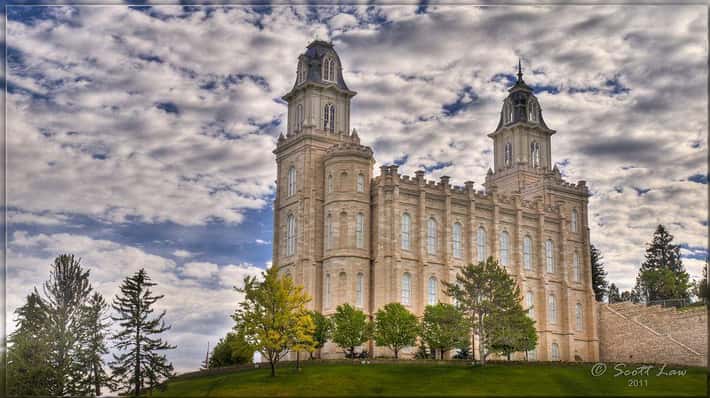
The temples and the saints of yesteryear were few, rural, Western, quirky and eccentric, and often but not always beautiful in an unusual way– homespun high art. (more…)
I had already figured out that our teenagers weren’t really doing the modest thing anymore.
I had also gathered that there is a mini trend of endowed Saints going about sans garments much of the day.
But I wasn’t expecting to go to a BYU married student ward and see several women dressed in a way that is incompatible with garments. Or all the guys with skanky long hair. Or the string ties (that one I liked).

O tempora, O mores.
My father’s hands are rough and wrinkled.
The dark stains left from scrubbed-off dirt and grass and grease.
The little hairs, the ink from where he drew
with engineer’s precision
plans for the pastures on yellowed graph paper
at the kitchen table.
Once he held a bat with me and said,
“hold it like this, hands together, not too hard but like you mean it.”
My mother’s hands are swelled and toiled.
The pink wrinkles on the knuckles from soaking in the dishwater.
The speck of dried dough she picks off when she notices,
the callus from the needle,
the lotion smell from the endless struggle against
the marks of struggle.
I remember days when she held up my hand to look at in hers and said,
“yes, you really did a number on yourself, let me wash it out and bandage you up,
let’s be more careful!”
My Savior’s hands are run right through.
Times are when reaches down and grabs mine, pulling me
from the rough chaos of the water
into light and air.