Munificent Frugality
I have seen the claim, more than once, that if you are an aristocrat you spend as you see fit and then work out how to acquire the means to pay for it. Whereas if you start with your income and then decide what to spend based on that, you are bourgeois (aka middle class, but the term also includes business owners and such).
One theme of our exploration of virtue sets is that there are certain virtues that are obscure to our society. (e.g., the nameless virtue).
There are certain other virtues that have a strong class or sex link, and so are obscure with respect to the other classes or the other sex. This is often because the same virtue takes on a somewhat different form across these boundaries and so the assumption is that the virtue must not apply at all across the boundary because it doesn’t apply in exactly the same way.
But there are many many aristocrats who have been wrecked by an excess of munificence, and many sedate middle class people who should probably be a little less procedural. Dickinson’s A Christmas Carol is an entire story on the theme of the wreck of a bourgeois life lived with all frugality and no munificence.
Munificence:Prodigality::Thrift:Stinginess
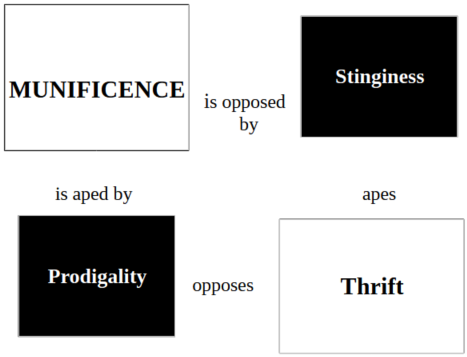
Americans are a generous people and it is part of our peculiar nature of being the most aristocratic of middle class people or the most middle class of aristocrats.

IAW
July 30, 2026
I recall reading an essay where the claim was the biggest difference between upper and middle class wasn’t so much how much money, but why they spent the money.
So middle class people buy expensive cars, houses and whatnot else because they want to show off to and impress people, whereas upper class people buy the more expensive thing because it works better and lasts longer (this is why, apparently, many millionaires live in modest houses and drive cars that cost a lot but don’t look it).
Not sure how true that is as far as labels go, but it’s interesting to ponder.