The Plan of Virtue
This is Part 3 of a series.
Part 1 was Virtue Upon Virtue. There we discussed that your standard virtue set could be disassembled and we could see the four different parts as stages or levels. Seen this way, they wouldn’t even necessarily be vices, if they were necessary parts of progression.
Part 2 was In My Father’s House are Many Virtues. There we tried to match the parts of a virtue set with the four afterlives and roughly succeeded–in particular, its eerie how well the astronomical symbols for each of the afterlives works. Outer Darkness = cool vice; the Celestial Kingdom = hot vice; the Terrestrial Kingdom = cool virtue; and the Celestial Kingdom = hot virtue.
In this part we are going to look at the plan of salvation and see if we can match its stages to the parts of a virtue set.
Background
In a virtue set there are two types of virtues and vices. The hot type is the virtue of going after good with gusto (or the vice of pursuing some good immoderately in exclusion of other goods). These are associated with glory, the sun and air, action, zest, and so on.
The cool type is the virtue of avoiding evils with thoroughness (or the vice or avoiding possible evils immoderately to the exclusion of seeking the good). These are associated with wisdom, the earth and water, prudence, intellect, and so on.
Background reading:
Satan Divided Against Himself (WJT)
Two Types not Four (WJT)
Second Consciousness
Before we get to the plan of salvation itself, there are a few points we need to get down.
The first is the idea of second consciousness. It’s an idea I’ve picked up second or third hand from I think Owen Barfield. My version of the idea is a folk or naive version, which is fine by me. In short, the idea is that a person or an enterprise starts off naive and unself-aware and then becomes rational and self-aware and analytical but the real power comes from rationalizing and analyzing their way back to an improved and better understood version of the first naive and unself-aware state. A crude way of thinking about it might be of a bull with two pastures. The way for him to really enjoy his own pasture where he begins is to break into the other pasture and discover the grass isn’t really greener. Then he comes back to the pasture where he started but now more fully aware of its advantages.
You see reflections of the same idea which Barfield was reflecting in a number of different places. There is a glimmer of it in the smoothbrain-midwit–galaxy brain meme, where the dumb guy and the genius agree, and its only the 120 IQ guy in the middle who is too educated for habit and experience but not smart enough to reconstruct habit and experience from first principles.
Here’s another reflection: System 1 and System 2 thinking. System 1 thinking is supposed to be base thinking. Quick, intuitive, rules of thumb and stereotypes, unreflective. System 2 is more ‘advanced.’ Slower, analytical, sometimes counter-intuitive, methodical, logical. Here’s the thing though. At its best, System 2 thinking is supposed to develop back into System 1. Your hard won truths and insights become natural and instinctual.
I even think that the dominical paradoxes are sometimes reflections: what you preserve you must first lose.
Here’s another reflection: Become as a little child, the Savior says.
In short,
We shall not cease from exploration
And the end of all our exploring
Will be to arrive where we started
And know the place for the first time.
Through the unknown, remembered gate
When the last of earth left to discover
Is that which was the beginning;
At the source of the longest river
The voice of the hidden waterfall
And the children in the apple-tree
Not known, because not looked for
But heard, half-heard, in the stillness
Between two waves of the sea.
-T.S. Eliot.
Some Puzzles
The next points involve puzzles.
Here is a puzzle. Satan is the worst of the worst and of course he encourages and sometimes embodies a synthesis of the vices. He and his devils, however, are distinctly figures of the cool vice. Fleshless, resentful, fearful, scheming. Satan’s plan in the premortal existence–let nothing bad happen!–is pure cool vice. So where’s the missing villain? Where’s the archetype of hot vice?
Here is another puzzle. Christ should be the synthesis of all the virtues and I think he is when properly understood. I’ll get to that in a future post. But at least on the face, he’s more a hot virtue hero. He doesn’t plan ahead to avoid problems with the Pharisees, he just rushes into the temple. So where’s the missing hero? Where’s the archetype of cool virtue?
The Plan of Salvation
Here is the standard LDS account of the stages of the Plan of Salvation.
Premortal existence => mortal life => the spirit world => judgment and resurrection into a kingdom of glory (or outer darkness)
And here’s a gussied-up instance of the diagram that’s been chalked on a thousand Sunday School chalkboards.
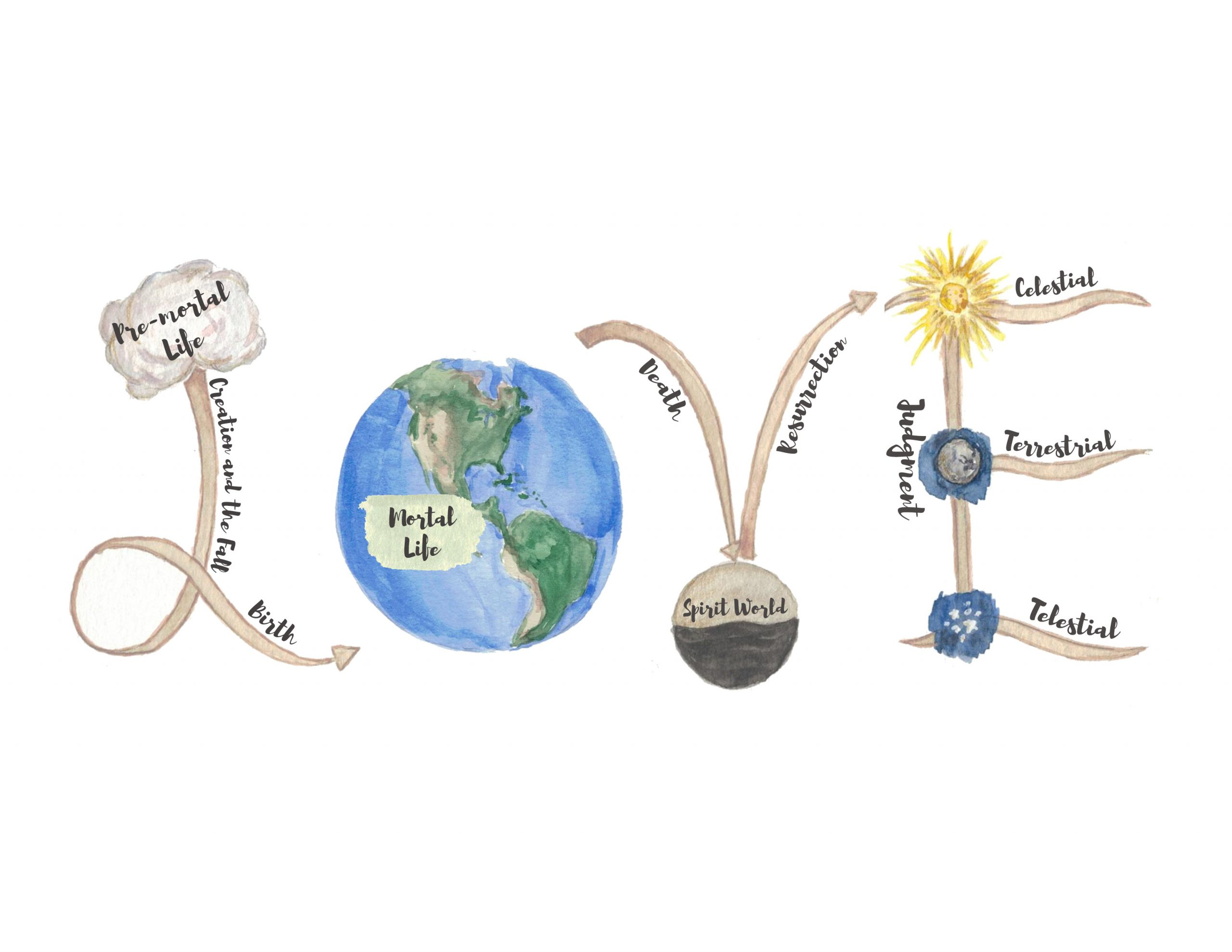
There is an obvious immediate fit given that the spirit is cool and the body is hot. Premortal life is cool, mortal life is hot, the spirit world is cool, and the afterlife is hot (the ideal or archetypical afterlife of course being the celestial world). Simple enough. There is even a lesson to be drawn, which is the importance of bodies and the physical world. Hot virtues seem to rely on it. The two hot stages come after creation/birth and after the resurrection. We think of virtues as inner states only, but understanding the plan of salvation as a plan of virtue shows how critical bodies are to it. Virtue can be physical.
Still, I think this is a superficial fit because I think its a superficial diagram. It’s meant to capture information from revelation, not necessarily to chart a meaningful life path.
The Plan of Progression
There are alternate ways of charting our progress. Lets set aside the spirit world. It’s a waiting area where most of the real action appears to be batting clean up from earth–reaching people with the gospel message who didn’t receive it in life. In fact, not everybody will even experience it! Plenty of people during the Millennium will skip it.
I am also going to set aside the Millennium for now. Its also a transitional stage that at least partly also is about finishing up mortal business–one last chance for the ordinances of the dead to be performed.
I think both the spirit world and the Millennium can be worked in, but its easier to start with them left out.
So what’s left? Inspired by the temple, we can come up with the core stages of human existence that looks like this.
Premortal Existence => Childhood (Garden of Eden) => Mortal Adulthood => Celestial Kingdom
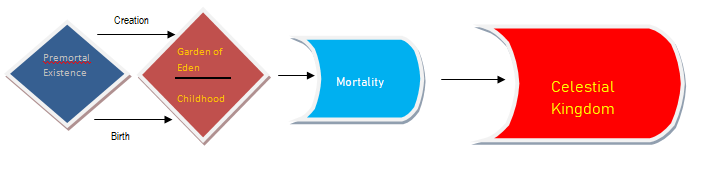
Premortal existence is the first spirit existence and it was the realm where Satan and his followers are stuck, so we would associate premortal existence with cool vice. Or rather than call it vice, we will just call it first stage cool. We could almost call it naive cool virtue, or the First Spirituality.
Then we go through an animal type experience where we are immersed in our bodies and our immediate experience. This is what the Garden of Eden was about. It is also what childhood is, especially when younger, especially when in the womb. There is a real innocence associated with this stage so we wouldn’t want to call it hot vice, but that is what it corresponds to on the virtue set. We can call it first stage hot, naive hot virtue, or the First Consciousness. As the child grows enough to start being able to make choices but still follows their impulses, as a child or as an adult, this is called the natural man. It is still the same stage, but now more clearly vice.
In fact, the natural man is our answer to the puzzle of what is the archetype of the hot villain the way Lucifer is the archetype of the cool villain. The answer is the natural man. The bodily experience without discipline and prudence and other ‘cool’ safeguards.
This verse, and in fact the verses around it, recap this whole post.
For the natural man is an enemy to God, and has been from the fall of Adam, and will be, forever and ever, unless he yields to the enticings of the Holy Spirit, and putteth off the natural man and becometh a saint through the atonement of Christ the Lord, and becometh as a child
Then we grow up, we have suffering and tribulation and cause and effect, we have to earn our bread by the sweat of our brow, and we have a chance to relearn and reembrace the cool virtues of patience, restraint, planning ahead, self-denial, biding our time, moderation, and so on. Done right, the archetype we become is the man of wordly wisdom as in Proverbs. What in some aspects you might call the mammon of unrighteousness. This is the second stage cool virtue, or what you might call Second Spirituality.
There are two different ways of looking at what happens next. The first is that we discover that our mortal prudence is not enough and we resubmit to God becoming as a child again, and then he grows us up again not as an adult mortal human but as an adult of our Father’s species.. The second is that we achieve enough discipline that we are able to re-embrace our passions and desires and body, but now with almost unconscious checks and guides we have developed over time that allow them to flourish instead of growing wildly like a cancer. This is the second stage hot virtue, or what you could call the Second Consciousness. To arrive fully at this stage is exaltation.
Premortal experience = incomplete cool virtue (something that is permanently incomplete is broken, vicious, a vice. But as part of a progression incomplete is ok and necessary). The childhood part of earth life = incomplete hot virtue. The mature adult experience of mortality = completed cool virtue. The return to power and glory and childlikeness both in celestiality in a renewed better body = completed hot virtue.
These four stages of growth also correspond with the four stages of the afterlife.
Lamb and then Lion
Notice how the Savior’s two comings in the body recapitulates the last two stages. First he comes as Lamb. He submits himself to mortal limitations, even starting out as a helpless baby. He suffers. He could use power to save himself but he does not. He submits to force.
The second time he comes in power and glory and now all kneel before him.
If we wanted to extend this further, with apologies to Marcion, we could identify the pre-earthly Jesus who is offering a plan and disclaims the glory as a ‘cool’ figure. Then he becomes the creator, Jehovah, the ruler and king–a hot figure. Then there is his mortal life, where he becomes lowly and even though he has a temperament is still functionally a ‘cool’ figure whose glory is set aside for later. Then at last he returns in power and glory and might once again as the ruler.
There is a tension between this model and the Plan of Virtue model. There we want to identify childlike times as part of the hot, whereas here we are tending to identify them as part of the cool. It needs more thought.
Evaluation
I realize this model of the Plan of Virtues is not perfectly clean and to some it will look like forcing patterns to match. But even though this particular application is not as logical as some of the virtue set work it is based on, it feels right to me. It tastes good. I don’t feel like I have caught the truth yet but I feel like the hounds are baying and we are in pursuit.

milkman
July 24, 2021
This reminds me of Alma 38:12 Use ???boldness?, but not overbearance; and also see that ye ???bridle? all your passions, that ye may be filled with love; see that ye refrain from idleness.
As a bridle is used to direct a horse for our purposes and achieve far more than could be done otherwise. In this case harnessing our passions fills us with hot virtue