Introducing Virtue Sets
Friday morning at 3 AM I woke up with a number of ideas about my virtue charts bubbling through my head. I got up and wrote them down for later posting. Before I did, though, I decided to recap the fundamentals of a virtue chart here.
Then I saw the hand of God at work. JG friend WJT posted a link to his own remarkable work building on the virtue charts, and much of what he had to say deeply complemented my new ideas. I felt that expansive feeling you get when your own work gets supplemented from up high.
But before I get to those, let me just briefly introduce the fundamentals of WJT’s virtue sets. Whereas I had just used the charts as a tool for investigating particular virtues and vices (which is why I called them charts), he perceived that each chart was just a particular application of a fundamental set of relationships between grand categories of virtues and vices. He called it the virtue set, which is the term I will now be adopting. You can read his posts here, which have the basic idea plus a number of additional insights. You really ought to read his basic idea post, at minimum. It is masterfully done.
Basically, he sees two main categories of vice, vices of a lack of passion and strength, and vices of uncontrolled passion and strength. He sees two main categories of virtues, virtues of passion and strength, and virtues of control and discipline. (There are probably better descriptions then I am giving here). He calls them Luciferic and Ahrimanic and Ahuric and Devic respectively. I don’t like those terms but may end up using them if I cannot come up with better ones. More on that later. Here is his master diagram.
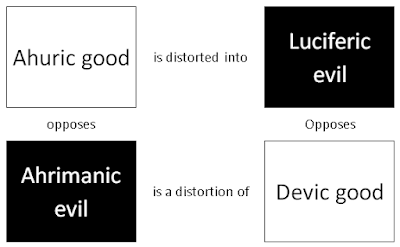
Conclusions so far
A. Each virtue has two vices. The vice that is the contradiction of the virtue and the vice that distorts the virtue. You could describe the contradicting vice as the vice of not having enough of the virtue, and the distorting vice as the vice of having too much of the virtue.
B. Each virtue also has a complementary virtue with which it seems to be in tension. (E.g., boldness and prudence). The complementary virtue matches up with the same two vices, but the vice that distorts the original virtue opposes the complementary virtue and the vice that opposes the original virtue distorts the complementary virtue. (E.g., being rash distorts boldness and is opposed to prudence. Timidity distorts prudence and is opposed to boldness).
C. The two complementary virtues and the two complementary vices that match with them form a virtue set.
D. The complementary virtues form very powerful combinations. The complementary vices form very dangerous combinations.
E. In a virtue set, one complementary virtue will be a virtue of strength and passion. The other complementary virtue will generally be a virtue of control and discipline. The matching vices will be vices of uncontrolled strength and passion and vices of a lack of strength and passion. In other words, there is a master virtue set of which the individual virtue sets are just instances.

William James Tychonievich
May 24, 2021
Very much looking forward to your further thoughts on this topic. I think we’ve got some creative synergy going here.
By the way, you’re not adopting the term “virtue set” from me. I got it from you; you introduced it in the original “Charting Virtue” post:
“The combination of the virtue pair and the vice pair on a virtue chart is a virtue set. The example above charts the modesty-comeliness virtue set.”
Lehis_student
May 24, 2021
The virtues seem to have agency in the mix. The vices reflect being acted upon.
E.C.
May 24, 2021
I . . . was literally just talking about this concept with my brother on Saturday! We were discussing a riddle song I’m in the process of creating for a story, and he pointed out that there is a vice that opposes a virtue and one that distorts, and that I seemed to be using the distortion rather than the opposition vices of the virtues.
Basically what I’m saying is, I like all your ideas on this subject, and I am totally stealing the concept for use in said story . . . with riddles.
G.
May 24, 2021
We would love for you to share your riddle song if you can.
The synchronicity that is going around here mean something
Evenstar
May 24, 2021
E.C., is your song like the riddle poems from the Hobbit?
E.C.
May 24, 2021
It’s in the form of ‘Riddles Wisely Expounded’, a Child ballad. You can find my inspiration here: https://www.youtube.com/watch?v=YAAm_cJGvZ8
I hope I can at least not butcher its delightful form. A part of my story is actually loosely based on the ballad.
E.C.
May 24, 2021
The rough draft of the first two thirds of the riddle song – virtues and vices:
What is dark as mirrored glass?
And what is brash as burnished brass?
What blinds sight like moonless night?
And narrows vision as the light?
What cuts deep as all that’s borne?
What quells as trees are choked by thorn?
Despair is dark as mirrored glass
Cruelty’s brash as burnished brass
Trust without sight is as the night
Obsession narrows sight in light
Regret cuts deep as all that’s borne
Smothering love quells as the thorn.
What settles slow like morning dew?
And what grows stronger in the true?
What expands vision like the light?
And what gives trust its greater might?
What makes burdens nothing weigh?
And what is longer than the Way?
Solace slow settles like the dew
Courage grows stronger in the true
Wisdom gives vision like the light
Loyalty doubles trust’s great might
Repentance lifts all burden’s weight
And love is longer than the Way.
I realize that not all of these are perfect distortions, but they are all elements of the story, so . . . close enough.