The Trickster God

The story of Adam and Eve, Mormonly understood, makes a mockery of the idea of salvation under the Law.
The standard Christian view is that Adam and Eve were given a strict commandment not to eat the fruit, the Serpent tricked them into eating it, so God in his anger cast them out of Eden. The Mormon view is that Adam and Eve were given two commandments which could not both be fulfilled, so one (don’t eat the fruit), had to give way to the higher one (multiply and replenish the Earth). Adam fell that men might be.
Elder Oaks explained, more clearly than I can ever hope to, the Mormon belief that what Adam and Eve did was a “transgression,” not a “sin”:
For reasons that have not been revealed, this transition, or “fall,” could not happen without a transgression—an exercise of moral agency amounting to a willful breaking of a law (see Moses 6:59). This would be a planned offense, a formality to serve an eternal purpose.
The obvious theological objection to our doctrine would be: “God is perfect and perfectly just, so why would he give a commandment knowing that it could not be fulfilled? How is that fair?” As Elder Oaks says, the need for such a transgression has never been fully explained, and I admit that this one used to bug me a little when I was younger. Eventually I shrugged it off; it was a one-off deal, so why think too hard about it?
Then I served a mission, got married, had kids, and realized that God gives impossible commandments all the time.
No commandment is impossible in an absolute sense, mind you (I see you, Nephi 3:7). It’s only when you take them all together. For example, if I were truly devoted to my calling to the extent that I am commanded to be, I would have to cut considerably back on time with my family (“No Other Success Can Compensate for Failure in the Home”). Or if I were to put my foot down and say, “No, I won’t compromise on my calling or my family duties,” then I can compromise my ability to perform the job I’m paid a salary to do (“Are you honest in your dealings with fellow man?”) or cut back so completely on sleep and other healthful habits that I cannot possibly claim to keep the Word of Wisdom.
Now, I’m absolutely the wrong person to point this out, because I’m a lazy fool who comes nowhere near the limits of my ability to follow the commandments. But even in those times when I’ve given my full measure of devotion, there was simply no way I could have done it all.
[There are, of course, a few Elect who possess the superhuman ability to keep all their earthly and spiritual commitments to the letter. They are known as Stake Presidents and their Wives, and the less said about this inscrutable, alien race, the better.]
So, we have plenty in common with Adam and Eve on this point. We have to make difficult choices between competing commandments, and we know that we will be under condemnation unless…
…unless someone makes up the difference.
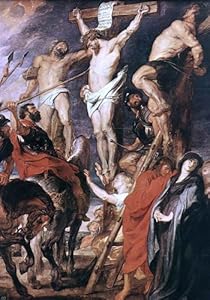
So much for the “fairness” complaint.
It still seems odd that the Father would set up the inherent contradiction of commandments that couldn’t be obeyed. But consider the alternative. How can mortals truly become the heirs of God when they’re only asked to do what mortals can do? And it’s not just this notion of “shoot for the Moon and hit the barn.” Our modern world labors under that secular form of Legalism known as “Equality.” Equality is a flattening of human expectations, wherein we minutely calibrate the demands of morality to prevent the tragedy that one man might be asked to bear a burden slightly greater than another.
Alexander Solzhenitsyn really had our number:
Western society has given itself the organization best suited to its purposes based, I would say, one the letter of the law. The limits of human rights and righteousness are determined by a system of laws; such limits are very broad. People in the West have acquired considerable skill in interpreting and manipulating law. Any conflict is solved according to the letter of the law and this is considered to be the supreme solution. If one is right from a legal point of view, nothing more is required. Nobody will mention that one could still not be entirely right, and urge self-restraint, a willingness to renounce such legal rights, sacrifice and selfless risk. It would sound simply absurd. One almost never sees voluntary self-restraint. Everybody operates at the extreme limit of those legal frames.
I have spent all my life under a Communist regime and I will tell you that a society without any objective legal scale is a terrible one indeed. But a society with no other scale than the legal one is not quite worthy of man either. A society which is based on the letter of the law and never reaches any higher is taking very scarce advantage of the high level of human possibilities. The letter of the law is too cold and formal to have a beneficial influence on society. Whenever the tissue of life is woven of legalistic relations, there is an atmosphere of moral mediocrity, paralyzing man’s noblest impulses.
So by obliterating the notion of salvation through the Law, and giving us commandments that he knew we couldn’t comply with, not all at once, not in this fallen world, our Father saved us from the damnation of mediocrity. The Ancient Greeks may have had it right about Hades: not a place primarily reserved for burning, but for bumming around.
Is this trickery? Does it impugn the perfection of God?
Let me turn that question around: What seems less consistent with the notion of a perfect God? That he gives commandments knowing they can’t all be obeyed? Or that his plan for his children is so flawed that it can be subverted by the solo effort of a two-bit trickster disguised as a snake? (A snake! He’s barely even trying to hide it!)
The more I think about it, the more I love the way the story of Adam and Eve has been flipped around by Mormonism. Not for us the humorless God who demands perfect obedience, gets outwitted by Satan, and then goes immediately to Plan B.
No, our God set it all up so that his worst enemy would play right into his hands! And then he sets us up for a “Fall Forward,” just like a father should. A father tells his daughter he won’t let go of the back of the bike…until suddenly the child looks back, and sees that she’s been tricked into learning how to ride without help. A father tricks his son into trying to score a 0% on his school tests, thereby turning him into a perfect student: http://www.visiontimes.com/2015/12/26/father-tricks-son-into-becoming-a-top-student-by-scoring-zero-on-tests.html
God is a Father, and fathers are good at tricking kids for their own good.

Filed under: Birkenhead Drill,Deseret Review | Tags: Adam and Eve, law, LDS, the fall
Steve
September 12, 2016
Ok, so interesting take first of all, I think there are some good points and parallels here but I want to take issue with the idea of keeping the law and the context which you presented it here. Lecture 5:2 states in part: “But notwithstanding all this, [Jesus] kept the law of God, and remained without sin: Showing thereby that it is in the power of man to keep the law and remain also without sin. And also, that by him a righteous judgment might come upon all flesh, and that all who walk not in the law of God, may justly be condemned by the law, and have no excuse for their sins.”
Cutting back on time with the family or allowing work to suffer a little due to an imbalance of some kind is not sin. Jesus was one accused of showing up too late to save Lazarus and had everyone weeping because of it. He also was sleeping while his fellow apostles were panicking in a storm. You could argue that he was “tricking” them but I think there’s a genuine scheduling conflict going on there along with genuine weariness. But that isn’t sin and it isn’t breaking the law.
It is in our power to keep the laws of God otherwise there would be no justice. I think there seems to be some confusion as to what God’s laws are versus patterns of living suggested by leaders and temple worthiness questions, and sin. I don’t know that this article helps contribute to clearing any of that up.
It’s true that parents intentionally trick their kids for their own good, I know that I’ve done this with my kids. However, I see the garden of Eden story in a particular way that I haven’t really heard anyone else suggest, but it makes sense to me. We all have our own interpretations I suppose and I think that’s fine.
Since we are on a parenting trip, another parenting parallel applies. A father calls his children to come to the table and sit down and they obey, but he tells them not to touch any of the food and walks back to the kitchen. But cousin Lucas is visiting and he sneakily suggests to the other kids to grab some fruit from the basket. The kids object, “No, daddy told us not to” but Lucas wants to them to break the rules with him so he pressures, “Look, it’s dinner time and we’re going to eat it anyway, why not take a taste now, your Dad’s in the kitchen, nobody will know!”
The kids take a bite and when Dad sits down he sees them chewing and asks, “Hey, didn’t I tell you not to eat anything? We haven’t had prayer yet!” The kids blame Lucas and Dad gives him the stink eye.
Now this isn’t a perfect parallel, and I had some fun with the story, but being the champion of liberty that our Father is, I’m sure that he knew what would happen in advance, as he does with virtually everything else but allowed it to unfold. No trickery, just agency.
In my story, the Father intended for the kids to eat, but he had his own time table and terms. I don’t believe that God gave them two competing commandments. True he commanded them to multiply and replenish the earth, but they may not have understood that commandment at first, perhaps they thought he was talking about them being fruitful in labor and in tending the garden; they were innocent and like children after all we are told.
Perhaps God’s ultimate intention was to educate them over time, because he does say that he will return (what for?). Then you have the serpent, he does what he has always wanted to do, get people to follow them. He wants to teach them about the fruit and be their God. Sure he’s bitter, but he can’t help himself in jumping in whenever he sees the opportunity to be the god of this world. So if there was any trickery or misrepresentation, I think someone else was responsible for that.
No matter, the fruit was partaken of, that was the next step anyway. The inevitable fall happened and Satan was reprimanded for his choice to intervene in business that wasn’t his own. Adam and Eve figured out that they needed to partake of the fruit to progress and that was the important thing. If Satan really wanted to frustrate God’s plan he would have done nothing and let Adam and Eve just sit there childless in Eden or have tried to convince them at all costs to never partake of that fruit because the whole world would turn terrible if they did.
Perhaps God’s next visit without any fruit being partaken of would have been something like, “Ok, I’m back, thank you for your faithfulness, let’s talk a little more about that fruit…”
But I think Satan knew that no matter what he did, the plan would move forward. I don’t think his plan is ever about winning or stopping the plan. The one thing he wants is to be obeyed. For people to obey him rather than God, to be more convincing than God, to be considered the better light to follow. In this he obtains his momentary glory and honor as Adam and Eve and droves of their descendants choose him over their Father. He can’t win in the end, but he can feel victory in only this one thing for a moment. It’s his drug and he needs his fix.
Geoff B
September 12, 2016
Excellent and thoughtful post, thank you!!!
Bruce Charlton
September 12, 2016
Very good argument.
Although I personally did strive never to trick my kids in the way you describe! My general attitude to honesty is that you either tell the truth, or say nothing – and I wanted my kids to be able to rely on that honesty in all matters, great and small.
In general, it seems to me an error to build too much detail upon the account in Genesis – since it seems from internal evidence to be one of the least literally and most poetically/ symbolically true parts of the Bible.
As CS Lewis made clear for me, this is not liberalism or modernism, or wriggling; but simply reading competently.
Some parts of the Bible are poems (Song of Solomon), some parts are histories (Exodus), some prophecies, some poems, some parables – large (Ruth) and small (Christ’s), some I just don’t know what (Job!)… there are all kinds of writings.
Some are for all time and everybody (much of the Gospels, but not all of them), and some for specific times and places (Leviticus, most obviously).
In general, for the past 200 years Christians have become used to reading the Bible defensively – as if being cross-examined i court by a prosecuting attorney who is trying to discredit it.
People are terrified to made any admission of anything but legalistic literal truth, because they think (correctly) that in the public space this will be exploited against Christianity.
But then inerrancy and ‘literalism’ is also exploited against Christanity. We can’t win!
Among ourselves and for our own purposes, I think Christians need to be free and creative and prepared to change their minds (and back again!) about the Bible – in a context of Genuinely Good Intentions – and a solid base in the essentials.
(This being True ‘Fundamentalism’!)
MC
September 13, 2016
Steve,
Without getting into the weeds about Jesus’ actions towards Lazarus, etc., I see your point about scheduling conflict not being a “sin,” strictly speaking. But you might have noticed that the word “sin” only appears once in the article, to express the idea that what Adam and Eve did was not a sin, but a transgression. That’s my comparison point.
In any event, Mormonism has a rather expansive view of the concept of “sin”:
“And finally, I cannot tell you all the things whereby ye may commit sin; for there are divers ways and means, even so many that I cannot number them.” Mosiah 4:29
“O that I were an angel, and could have the wish of mine heart, that I might go forth and speak with the trump of God, with a voice to shake the earth, and cry repentance unto every people! […] But behold, I am a man, and do sin in my wish; for I ought to be content with the things which the Lord hath allotted unto me.” Alma 29:1-3
So no, failing to do all that one is urged to do is not necessarily sinful in the way that breaking one of the Ten Commandments is sinful. But I think I’m on fairly sure ground to say that this particular human frailty falls “short of the glory of god.” I perceive it that way in my own life, YMMV.
MC
September 13, 2016
BC,
I’m not a strict literalist on the Eden account either*, which is why I think it’s fruitful to look at their predicament as something all of us face to some extent or another.
*I rather like Brigham Young’s speculation that there could have been many sets of Adam and Eve. It could be that every Eden was a ceremonial induction into the human family.
Jared Cook
September 14, 2016
Nice post. This is, of course, straight out of Paul (not to mention being all over the Book of Mormon): the point of the law was never to sanctify us itself, but to force us to come face to face with our inability to keep it, and drive us to faith in Christ. The law is our schoolmaster, as Paul says, not because by keeping it we learn about Jesus, but because by trying to keep it, and failing, we learn of our need for Jesus.
G.
September 14, 2016
I mostly agree with your essay, @MC, though I would frame it differently.
The Garden of Eden story has two commandments that contradicted each other. It was impossible to obey both. Not just so-difficult-as-to-be-tantamount-to-impossible. Actually impossible.
I see this as reflecting a fundamental truth about how reality is and must be structured. Growth requires doing things you have not mastered yet. But doing things you have not mastered yet means you will screw them up. When we inexperienced amateurs decided that we were going to work at knowledge of good and evil until we had reached divine mastery level, the same as the gods had, it was inevitable that we would make choices that screwed up good and evil. Screwing up good and evil is sin. But it would also be sin–“damnation”–for the children of God to not want to be like Him. Hence the contradictory commandments.
Put differently, to act in a world where choices have consequences is to be responsible for those consequences. However, only an omniscient and omnipotent being can actually fulfill the responsibilities that action brings. Taking responsibility that you cannot fulfill is sin. Refusing to act is sin.
Andrew M.
September 14, 2016
Two great books about the Fall are Paradise Lost, by Alonzo Gaskill and Eve and the Choice Made in Eden by Beverly Campbell. I don’t believe the choice was because of a trickster God, or a mistake, or plan B situation, or deception, or prevarication. Eve and Adam make the correct decision, with full knowledge. God instituted laws or “the Law” whereby we could become like Them. Application of the law is not a matter of perfection now, but growing into Gods’ fullness over time. So the persistent question is – are you growing now? Do you intend to keep all of God’s commandments? You do? Good! Carry on.
The various instances of the Eden story have many world-building and world-shaping metaphors, but I would not confuse them as history.
@Bruce Charlton, I disagree about Leviticus. Some of the practices go away, but the symbols are for more than a limited place and time.
JRL in AZ
September 14, 2016
I don’t have anything good to add to this discussion, but I do want to say that Eve and the Choice Made in Eden, as suggested by Andrew M. above, was one of the best things I have ever read about the Fall. And about women. It was wonderfully perspective-altering. I recommend it to everyone I can.
G.
September 15, 2016
I’ll have to read the book before I judge, but I am deeply allergic to the Mormon cultural trend to sanitize our doctrines and remove the tragic, painful, and bitter. And a lot of the Felix Peccata attitude that I encounter is all felix, no peccata.
Vader
September 15, 2016
G., I agree, but it strikes me that three LDS depictions of the Fall story I’ve seen recently seem to emphasize that the Felix Pecatta was a terribly painful path to take. One does indeed wonder if there was no other way.
G.
September 15, 2016
Good to hear, @Vader. That is the approach that is the most true to life.