Loneliness (Pain and Suffering for Lent)
No one knows you or cares about you. maybe they would help you if you begged–but they would help you as strangers, or with their teeth gritted.
We hid as it were our faces from him
No one knows you or cares about you. maybe they would help you if you begged–but they would help you as strangers, or with their teeth gritted.
We hid as it were our faces from him
It’s a part of your body you don’t normally notice. Now you do. It’s not acute but it just nags at you. You can’t take anything for granted.
You want… friendship, love, to be one of the guys, an opportunity to prove yourself. And you don’t get it. No. Not with us, they say.
Maybe its you, you don’t know.
He was despised and rejected of men.
There you are, moving along like you have so many times before… ouch! Dang dang dang! You’ve stubbed your toe.
Which actually tells us a lot about the mortal condition.
Kings shall see that which they have not considered
One moment you thought everything was fine, you were among friends, then something happens and your face burns and they are all laughing at you. It feels awful.
Even years later, you can feel your gut clench when you think of it.
If it happens enough, or you worry about it enough, it becomes a permanent injury. You are always about to cringe. You have a permanent psychic injury.
Perhaps, eventually, it will lead you to either Pride or the peace of Humility. But either way, it hurts.
He was despised and rejected of men.
You are bored, you are flat and restless and irritated and dull.
I spur to action, to mischief, or sometimes to nothing.
That acid taste of despising yourself. Perhaps in some distant day you will look back and see it as a spur to repentance and growth. But for now it is just a bitter fire of feeling sick at who you are.
When the bells justle in the tower
The hollow night amid,
Then on my tongue the taste is sour
Of all I ever did.
Why callest thou me good? there is none good but one, that is, God.
It’s annoying. If it goes on, almost maddening. Sometimes it is a warning or a precursor of worse pain to come–stop now while you can!–sometimes it is a sign of healing–sometimes its just an itch. Part of the mortal experience.
It is all hopeless. There is no point. You despair.
Today marks the birth 250th years ago in 1776 of Mary Pickersgill, who crafted with her household the gigantic Star-Spangled Banner that Major Armistead hoisted over Fort McHenry. Were you in Baltimore at mid-day you could have gone to her home for a piece of cake.
(The Baltimore Banner)
“Pickersgill’s story begins with that of her mother, Rebecca Young, who opened a flag-making shop in Philadelphia after her husband’s death. Young Mary worked alongside her.
“When Pickersgill’s own husband died, she followed in her mother’s footsteps. Pickersgill, her young daughter and her mother moved to Baltimore in 1806 to be closer to family. They started making flags in their brick three-story home at the intersection of Albemarle Street and what was then called Queen Street, but we now call Pratt.
“Pickersgill and her mother placed newspaper ads inviting ‘military gentlemen’ to purchase ‘Silk Standards & Cavalry Colors, and other Colors of every description, finished in compleat order.'”

For Lent, I conceived the quixotic notion of posting about some different kind of pain and suffering each day.
Here’s the list of what I have got.
Any suggestions or refinements would be welcome.
Your world is dark.
Perhaps it was always dark. You only see colors, if at all, in weird flashes in dreams.
Perhaps it came on you. You can still remember the light.
But now you are blind. Your eyes stare without sight.
There are compensations–your other senses get sharp There are kindnesses. But this is a world for those that can see. Every hour, every day, you are blind and need help or to live in a rigid constraint. Perhaps you are cheerful about it. Perhaps not. But if you could, you would see.
You cannot.
And thou shalt grope at noonday, as the blind gropeth in darkness, and thou shalt not prosper in thy ways
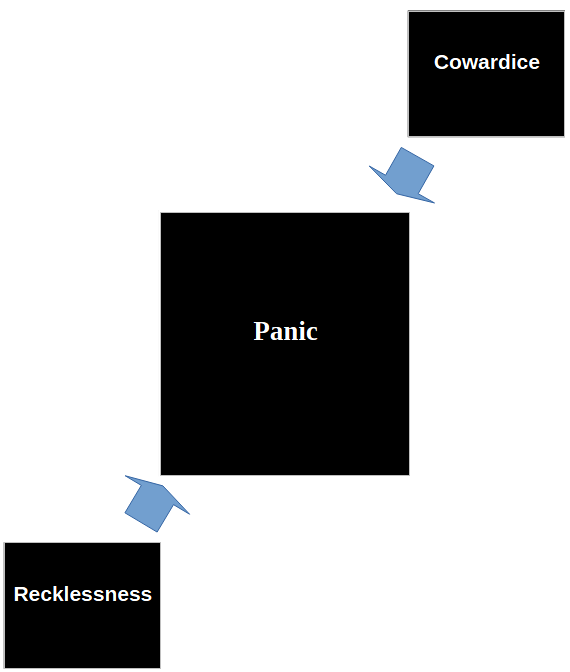
There once was a rabbit whose sire was named Recklessness and whose dam was named Cowardice. Now in that warren at that time the weasels and other predators became so numerous and bloodthirsty that the rabbits determined to leave. They set out into the unknown forest but by ill chance a band of wolves came across their scent and started to follow them. The rabbits fled in good order until they came to raging water flowing through steep and rocky banks. They were almost in despair, because the wolves were not long behind, until one of the chief rabbits found a log laying across the rush of the waters. It was narrow and uneven and wet, and rabbits were not climbers and balancers by nature, but the chief rabbit thought that by courage it could be done. He cajoled the other rabbits and one by one they made the frightful attempt. All except the rabbit whose sire was named Recklessness and whose dam was named Cowardice. With great gasping breaths and wide staring eyes he sat immobile, frozen with fear. The chief rabbit pled with him, bumped him, whispered love and affection and courage to him, but still he sat frozen, until in a few minutes the wolves came and the chief rabbit had to dash for the log and barely escaped with his life.
When the wolves came, the frightened rabbit fled madly, blindly, off the edge of the bank and plunged into the frothing current below, where he died.
The name of the rabbit was Panic.
When you are used to being clean, and you are dirty. It gnaws at you.
When you are used to being attractive, and you are now scarred, or fat, or disfigured.
When you were never used to these things, but you have always been scarred, or fat, or disfigured. You see the thousand subtle ways people treat you differently without even realizing it. Sometimes with kindness, but still treating you differently. You are mostly used to it, but sometimes it stabs.
Sometimes you are invisible. Sometimes you are acutely visible. It hurts. You find refuge in being alone or in being online or in charm and accomplishment.
he hath no form nor comeliness; and when we shall see him, there is no beauty that we should desire him.
My mother once observed she really didn’t understand the Doctrine of the Family. Please understand, I am the eldest of eight. And my mother is no doctrinal lightweight. It was real life and experience and problems that showed her the Primary-level version of the doctrine, that we sometimes teach, needs more depth.
So why do certain people come to certain families? People of unlike skills and even unlike spiritual sensitivities. Is this arbitrary, or are people placed there on purpose?
There are families where a single theme dominate, like families of lawyers or doctors. There are even families of mathematicians, like the Bernoulli’s. There are some advantages to specialization. But I see more families with a spread of talents and abilities, temporal and spiritual.