A Cure for Depression
I felt low in spirits this morning. Something said to me then,
the purpose of the Gospel is to bring forth Majesty in the soul
That thought was at the same time the cause of my depression and the instant cure for it.
I felt low in spirits this morning. Something said to me then,
the purpose of the Gospel is to bring forth Majesty in the soul
That thought was at the same time the cause of my depression and the instant cure for it.
This is the Official JG Review of Catherine Pakaluk’s forum at BYU, as previewed by our very own John Mansfield.
Why Children Became Useless: Faith and the Future of the Family
Attendance: High. The Marriot Center felt full and had greater than average attendance for a forum.
Babies in Attendance: Low. We only saw 2.
The Bad: The first half of her talk didn’t hit the right note for the audience. It was too scholarly–not too deep, but just too focused on which of a number of competing abstract theories best explained the ongoing birth crisis, and it partook of the professorial vice of getting into quarrels with absent people. In this case, with people who believe the birth decline has structural causes. (I am one of them, I don’t think we are really ‘the richest and freest’ ever.)
The Good: Her biography and the quotes she read from her educated mothers of large families. The Spirit hit like a hammer.
I recommend the forum and strongly recommend the book.
In Chad H. Webb’s talk from this last conference, he says that when we are teaching any principle of the gospel, we ought to ask “Can you think of a time when Jesus Christ exemplified this principle?”
Which is a very interesting exercise for the principle of peacemaking. When people describe this gentle, non-confrontational nice-guy Jesus, I honestly wonder how we can be reading the same book.
Jesus broke the Pharisee’s rules right in front of their faces, explicitly to provoke them. He didn’t treat them as if they were arguing in good faith when they weren’t: in fact, he explicitly mocked their hypocrisy, calling them whitewashed tombs, a brood of vipers, children of hell.
He drove out the moneychangers who desecrated his Father’s house.
He told the Samaritan woman at the well that she worshipped she knew not what, and that salvation was of the Jews.
He then goes on to say, using President Nelson’s analogy, that peacemaking is more like surgery than it is being nice. Except
it’s not obvious where to cut, and you have to keep your hands steady while you’re taking all kinds of incisions yourself, and not necessarily in the right places, and it hurts, and it’s a mess.
The Savior’s way of peacemaking is the cross.
It’s not at all trivial. It’s not for the timid. It’s no wonder people don’t want to do it.
For ordinary people to do this is a miracle. Repentance — receiving a new heart, losing your disposition to do evil — is a miracle. There is no peace — within myself, my family, my country — without the atoning blood of Jesus Christ.
-thus EDJCB. Much more at the link.
Friend of the JG Bruce Charlton has an excellent post about starting with what you know.
Instead of taking an abstract ideological or creedal concept and then fitting your experience of goodness into that concept, start with goodness. You know what goodness is, you can live it, experience it, refine your taste for it–and then assume that God is like that, only more so. When He said He was good, He was speaking in our terms. (Yes, goodness can be demanding and inspiring, it’s not all grandfatherliness).
I would also add, you can just know God. You can just talk to the Father and the Son.
I would also extend this to atheists and materialists. A man can study and do experiments and come up with theories that he feel leads him to the scientific materialist conclusion, and then come up with epicycles to explain why most features of our existence are illusions. Or he can just accept the basic fact, that he himself experiences from day to day and moment to moment, of agency and meaning. He is swaddled in them.
Sidenote: I personally don’t believe that all children who die young are automatically saved, i.e., forced to be saved. Of course nearly everybody is going to be saved, whether they die young or not, so I guess the real question is exaltation, full participation in the divine family and friendship and companionship. For that I would say that either in divine providence only those souls who have already fully chosen die young or else those who die young will have other experiences and other chances to choose and grow in the afterlife or the millennium or elsewhere. There are other options.
Humility is rare among the great–the powerful, the famous, the rich, the beautiful, the gifted. But it is rare not just in being uncommon. It is rare the way a choice vintage is rare. True humility is only possible among the great.
Or among those who have begun to aspire. Poverty was not what made the poor among the Zoramites humble. It was poverty plus Alma showing them the possibilty of a better way.
The three things I enjoy about the modern age are flossers, water bottle filling stations, and the group chat.
So someone in the group chat (the family version) shared this wonderful product
The existential crisis duck lamp.
Then the knock knock jokes started.
When you enjoy the temple, you are becoming as a little child.
Verily I say unto you, Except ye be converted, and become as little children, ye shall not enter into the kingdom of heaven.
-thus Matthew 18:3 (KJV)
Somehow in the sacrament on Sunday I got to thinking about children’s stories. A lot of them have a lot of repetition and easily grasped structure. The Big Bad Wolf huffs and puffs at each house, using the same formula, and we go through a simple three-step progression from house type to house type. The ending is no sense a surprise, especially because almost always the child has heard the story before. The child wants the repetition of the same ol’ story they know and love. Children’s stories often don’t even have a plot structure. In Goodnight Moon, you say goodnight to things over and over.

The House Built Out of Stone
And there I was in the sacrament thinking about kid stories when the prayer for the water happened, in the exact same way it is always done, using the exact same formula, no plot, no surprises.
Basically, kids’ stories are a ritual. Sacraments are rituals. The temple is a ritual. If you enjoy them, you are letting yourself be as a little child. You don’t have to enjoy them–participation with faith and reverence is enough. But eventually you will need to enjoy them or you will not be happy in heaven. Heaven is a lot more like an old beloved story than it is like a new movie. You will have to become as a little child.
In heaven, only the stories worth retelling are allowed.
And then I had a vision–not a Vision, nothing miraculous, just something in my mind’s eye–of telestial and maybe terrestrial people happily wandering as adventurers through the infinite variety of creation, never bored, always finding something new. But the celestial people becoming as large as gods, seeing everything, feeling everything, as large as the universe, and deeply deeply happy because the all of everything was as familiar and belonging to them as the inside of their home.


Working under the car the other night, scraping off an old exhaust flange gasket to mate the catalytic converter with a new, not rusted and not leaking resonator pipe, I had a Merle Haggard album playing that I hadn’t listened to before. One song stood out as lyrically unlike anything I had ever heard anyone sing before. For those who uphold the family as a unit of production, here is a little tune to add to your collection.
The Singer is a widower keeping the family going, more wistful than bereaved with the loss of his wife at this point. He is well along into bearing singly the parental load meant for two, and pretty cheerful about it. As “the keeper of all that was yours”, leading my children in cleaning the house and keeping it in order was a significant piece of carrying on faithfully and nourishing the happiness and strength of the family my late wife and I had formed. That is the case for families not missing a mother as well. This is a true song. Enjoy.
=============
“Chores” sung by Merle Haggard
When I was a young man, I worked on my own
You had the big chore of makin’ a home
Now that I’m the keeper of all that was yours
I’m head of the family and I’m boss of the chores
(more…)
For the history-minded I strongly recommend this interview with Sean McMeekin, author of Stalin’s War and other books.
The great men of history are seldom humanitarians.
The national declines in marriage and childbearing are understandable for historic reasons, but Latter-day Saint values and practices should improve—not follow—those trends.
-President Oaks
The prophet is calling us to have more children. That means he is calling us to be extraordinary. We have to find a way to not be swept along with national or global trends.
As I write, it is Tuesday morning. Russell Nelson, President of the Church of Jesus Christ of Latter-day Saints died Saturday night, Sept. 27. That was two weeks plus two days and a night ago. His funeral and burial were Tuesday, Oct. 7, which was seven days ago. When he died the quorum of the First Presidency was dissolved. Seventeen days since Pres. Nelson’s death and seven days since his burial, the First Presidency has not yet been reorganized. This is unusual.
(more…)
Our President Oaks, with the approval of our prophet Russell M. Nelson, deplored the few number of babies among the Saints and tied it to many an LDS family being a consumptive family instead of a productive family.
Here I am going to outline the very basic principles of being a productive family for the many, many Saints who have enthusiastically embraced the prophets’ call and are wondering how to begin. Each and every one of you make us proud.
Many of our friends are already production-pilled. Please discuss what you know with the Church, especially friends and family, along with anything you learn here.
But first, a reminder of what President Oaks said to us in his first keynote Conference address: (more…)
President Holland pointed our attention at evidence for the gospel.
He told the story of the man blind from birth who was healed by the savior, and when asked to denounce Jesus as a sinner replied that he didn’t know anything about that, but he did know that he now could see.
How important evidence is, as opposed to wishes or argument or even malice in opposition to the truth.
Evidence is not the actual root of testimony. That is the Spirit–the peace of God which passeth understanding–sweet is the peace the gospel brings.
But it is also good, important even, to tally up the evidence that you also have.
Here is some of mine. (more…)
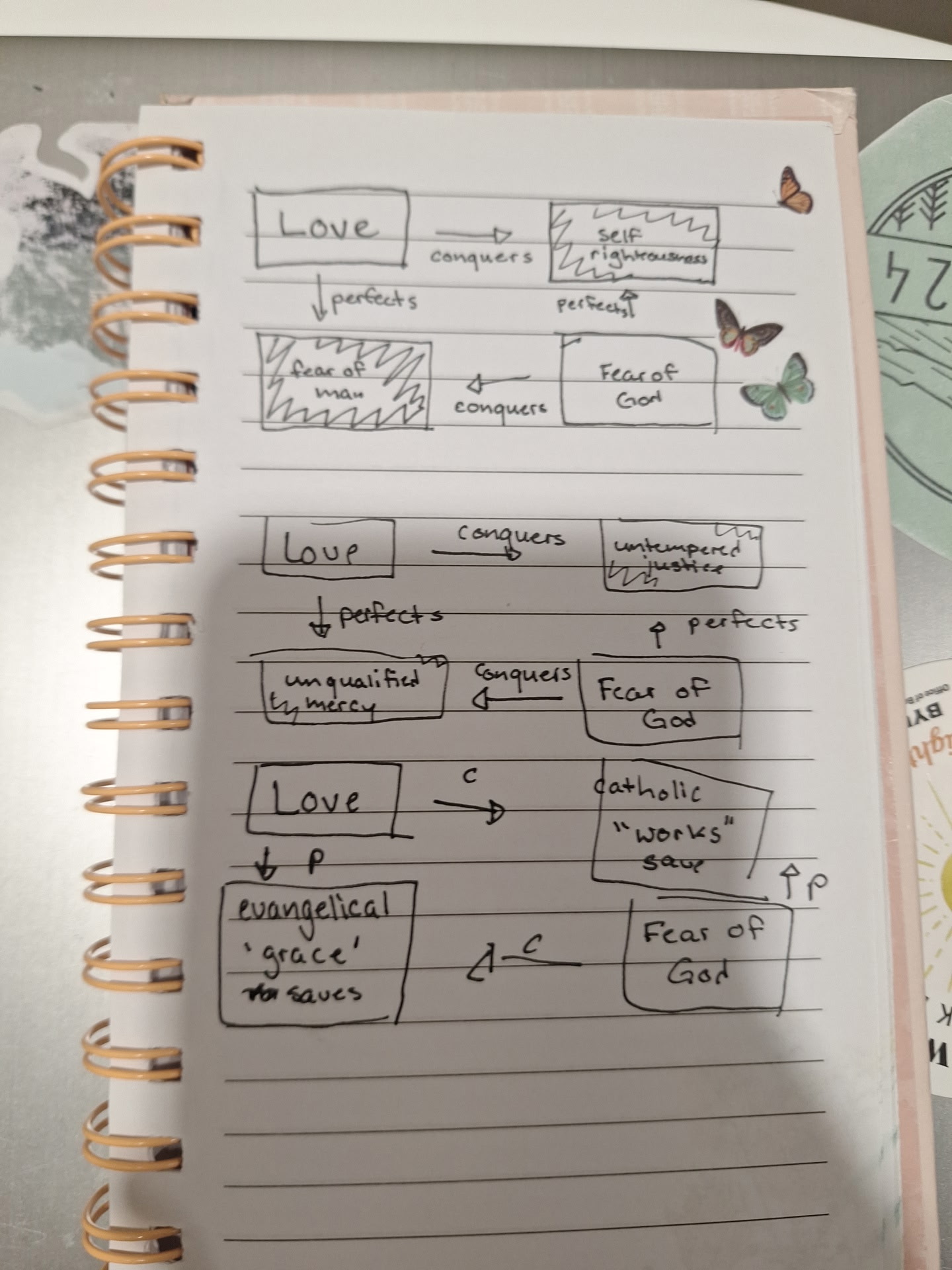
Yesterday I asked our friends about godly fear. You responded very well.
I am particularly interested in the suggestion in the first one that “fear of man”, i.e., caring what people think about you, is an imperfect or incomplete form of love.
And more
(more…)