Angina Monologue 32
His Majesty was in a happy mood this morning.
By which I mean he was in a monumentally sour mood. Nothing seems to give him greater delight.
It’s clear we’re going to lose this election, no matter which of the candidates actually gets a majority of electoral votes. Hillary’s campaign boils down to “I’m not Trump.” Trump’s campaign boils down to “I’m not Hillary.” Stein and Johnson are both campaigning on “I’m not Hillary or Trump”. And the distressing thing is that these would all be very convincing campaign strategies, if they were being pursued by almost any other politicians.
Hillary is endowed with the sweetness of Asajj Ventriss, while Trump projects the quiet dignity of Jar-Jar Binks. Both have the morals of Jabba the Hutt. Hillary should be in jail for the private email server and the Clinton Foundation and Trump for Trump University. Look, I needn’t belabor this point. Everyone but a few radical partisans on each side knows that these are dreadful candidates.
Johnson is disqualified for the same reason Ted Kennedy would have been disqualified even if he had not been a liberal Democrat: Perpetual intoxication. Neither I nor anyone I know has seen an interview with Johnson in the last year in which he did not appear to be either stoned or hung over. But there are other excellent reasons for rejecting Johnson as well, including his belief that it is libertarian for the government to force Christian bakers to sell wedding cakes to gay couples. I don’t much care about Christians, wedding cakes, or gay couples, but I dislike intellectual incoherence.
Stein is the kind of physician who can express doubts about the value of vaccination. Were she a lawyer or software engineer, this might be merely an irritating eccentricity. But a physician arguing against vaccines is analogous to an economist arguing that increasing the minimum wage will increase employment. … Yes, I know that a few economists have actually taken that position. Just as a few physicians have come out against vaccines. A pox on both their houses.
But, as I said, I needn’t belabor this point. This is not an ordinary election, in which none of the candidates is wholly satisfactory but the Republican candidate, at least, will probably not be a disaster and will be significantly superior to the alternative. Trump is not McCain. We are not talking here about choosing a hot dog over a crap sandwich when we’d prefer a nice steak. We are being asked to choose between a crap sandwich laced with cholera versus a crap sandwich laced with typhoid fever.
I apologize for burdening the reader with His Majesty’s sometimes blunt language. But I think it a mistake to Bowdlerize a Sith like Palpatine.
This raises three interesting questions. First, how did we get here? Second, how do we avoid a repeat? And, third, given that there is probably not a completely satisfactory answer to the second question: How do we minimize the damage when this kind of thing does happen?
First: How did we get here?
All kinds of explanations have been offered. The difficulty is not that they are all wrong: It is that almost all of them are at least partially right, but none seem to really get to the root of the matter.
The prevailing liberal narrative is that Trump gained the nomination by winning the support of the mass of ignorant white male Christian racists pining for Hitler who make up the Republican base. Because this conveniently supports the longstanding Democratic narrative, it is tempting to reject it out of hand. And certainly there are elements of it that do not stand up. For example, the more religious Republican voters were actually less likely to vote for Trump in the primaries than other Republicans. This was clearest among Mormons, who have been standouts in their rejection of Trump.
Of course — though perhaps I should not be the one to say it — a fair number of Republicans do not consider Mormons Christian, while liberals seem to consider Mormons to be Christian mostly when they’re using “Christian” as a pejorative.
And Trump, aware of his lack of Mormon support, has tried to woo evangelicals with a “See, I don’t like Mormons much either” line.
Add to this my anecdotal experience, that some of the most vociferous Trump supporters I’ve met are loudly agnostic or even contemptuous of Christians, and we can drop the “Christian” out of “white male racists that are pining for Hitler who make up the Republican base.” Christianity is not fundamental to support for Trump. It’s not clear it’s even correlated.
Actually, the hard numbers — to the extent one can trust hard numbers from the New York Times — show that Trump does poorly among WASPs generally, but quite well with Evangelicals.
So make it “nominal Evangelicals” rather than “Christians.”
Look, I’m a pragmatic Sith. I consider a person religious, not because they claim to identify with a particular faith, but because there is objective evidence of religious habits in the way they live. This is true in the subcategories as well: I consider a person Christian when there is objective evidence of Christian habits in the way he lives. Even if you believe in sola gratia, as presently misunderstood by many Christians, your habits will reflect your real beliefs. Most Christians, even of the grace alone variety, are not prepared to join Luther in ripping James out of their Bibles. So it matters to me that the “Evangelicals” who support Trump are the ones who are less likely to actually act like Evangelicals.
“Pining for Hitler” is pure rhetorical flourish. Such few commonalities as exist between Brownshirts and Trump supporters are either typical of any mass political movement, or are already covered by “white racists.”
As for their making up the Republican base: I’m not sure a man who has evoked such strong opposition from within his own party; for whom there is credible evidence that he drew much of his support from Democrats and independent voters in open primaries; and who drew much of his nominally Republican support from voters who usually don’t bother with primaries, can really claim that his followers make up the Republican base. This is not to say that I’m not distressed to find so much support for Trump among Republicans. But a Republican candidate who has managed to put normally reliably red states such as Texas or Utah into play is clearly not drawing off the usual Republican voters.
This leaves us with “ignorant white male racists”. With the other flourishes and half-truths stripped away, we’re left with the fact that Trump supporters are overwhelmingly white and male, and the Times data shows that they are unusually likely to be poorly educated. It is telling that white and male are now pejoratives in the minds of Democrats, revealed no more clearly than by the fact that the less rabid Democratic opinionistas are sometimes willing to leave out “ignorant racists” and just go with “white male”. Partly this is dog whistle: Democrats assume that their readers will understand that white males are largely ignorant racists, especially if they vote in Republican primaries.
The troubling thing is that some thoughtful Republican opinionistas essentially agree with “white male racists” as a description of Trump supporters, and marshal some pretty good evidence. You can’t easily dismiss race as a category describing Trump supporters when his non-white support is virtually nonexistent. The Christian aspect is mostly cultural, but then, in politics, religion is usually a cultural rather than salvific or theological matter. And perhaps “white identity” is not quite the same as “white racism”; Jonah argues that the burn these people feel is not that their racial superiority is being denied, but that their culture is not being given the love other ethnic cultures get from the Democrats. That may even be a legitimate complaint — though, as Jonah points out, nurturing it it is practically a capitulation to the Democratic ethnic spoils system.
So when you strip away the bull—-, the liberals who describe Trump supporters as “ignorant white male Christian racists pining for Hitler who make up the Republican base” really mean “people who have not gotten any love from us for decades, because of our devotion to ‘political correctness’, and now have the gall to throw their political support to the other party”.
(I felt like I had to Bowdlerize that one.)
The real problem with the liberal take on Trump is that it describes the demographic (poorly) but offers only an incomplete and unenlightening explanation for why the demographic supports Trump. “They support Trump because they’re white racists” ignores both that these are not the typical racist villains of liberal iconography and that the Democrats do not exactly have a history of refusing the support of such people. Until now.
I suppose you mean that the Trump supporters are not exactly Paula Deen basking in white privilege.
Certainly not. Although they are typically not descended from recent immigrants, they are probably the least likely of multigenerational Americans to have ancestors who owned slaves. I doubt most would care much about working alongside a black, so long as they had a well-paying job themselves. I could be mistaken; this is not a demographic I have spent much time with. But they are more like the poor whites who made up most of the Confederate armies (or Union, for that matter) than they are like the rich slaveowners who led those armies.
And, as I said, the Democrats don’t exactly have a history of rejecting the support of such people. Even the most partisan Democratic historians have to admit that the Democrats were not exactly the party of civil rights prior to 1964. (They excuse this with the claim that the Republicans and Democrats exchanged roles on civil rights due to Nixon’s “Southern strategy”, but this turns out to be mostly a myth.) Even after 1964, the Democrats continued to push the minimum wage and to court labor unions, which were not exactly pillars of racial equality. Both existed largely to protect white blue-collar workers from competition from poor minorities.
Of course, to say that poor white males form the core of Trump’s most earnest supporters is not to say that he has little support among those who are neither poor, white, nor male. Nor should we ignore the reality that many, perhaps even most, of Trump’s supporters are supporting him largely because he is not Hillary. It is difficult for me to be too hard on anyone who votes for Trump because he is not Hillary, given how dreadful a candidate Hillary is. But that cuts the other way, as well: I cannot really be too hard on anyone who votes for Hillary, including your children, given how awful a candidate Trump is.
(I have very mixed feelings about that. By the Emperor’s logic, which seems sound, I should not be too irritated at Luke and Leia for their announced intention to vote for Hillary. But I am. I think what irritates me is that so few Hillary supporters are prepared to acknowledge how dreadful Hillary is. But then, that’s true of Trump supporters. … No election in my lifetime has left me in such a churn of mixed feelings.)
I think, though, that we will be closer to understanding this election when we recognized this great truth: Republican leaders are, by and large, sincere in their conservatism; Democratic leaders are, by and large, hypocritical in their progressivism. Whereas Republican voters are, by and large, hypocritical in their conservatism, while Democratic voters are, by and large, sincere in their progressivism.
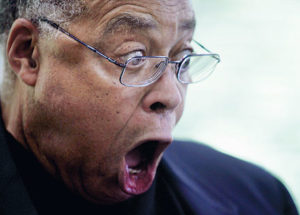
You needn’t act so surprised, Lord Vader. No need to go all James Earl Jones on us.
No, it’s not that. What flabbers my gast is that I didn’t think of that myself.
You’re too close to the problem. And you are too inclined to assume that most people are reasonably sincere in their political views.
Actually, my default assumption is that most people are unreflective in their political views, and wear labels like “conservative” and “liberal” (“progressive” having not really caught on except among a few of the more educated progressives, even though it is far more accurate) without bothering to understand what they really mean. But, you are right, My Lord: I tend to assume that, to the extend the average person has thought things through, he is sincere in the beliefs he espouses.
Come, Lord Vader. You are much too knowledgeable to not be aware of the problem of preference revelation. It’s not a matter of honesty, in the sense of personal integrity; it’s that the voter himself often does not know what he really wants until he is confronted with its real costs. Democracy as now practiced in the United States, with its highly progressive tax scheme, is superb at hiding real costs.
You told me once of a lawyer friend who specializes in family law. He had as clients a brother and sister who had reluctantly come to him seeking a custodial order for their mother. In court, when the poor lady was called to the stand, your friend made some small talk for a few moments, in which she appeared perfectly lucid. Then he asked her, in an almost casual way, how her checkbook worked.
After about ten minutes of conversation in which it became clear that the woman thought she could write all the checks she wanted, and the money was just there, your friend looked up to see the judge give him a slight nod. Message: You’re getting your custodial order. Don’t embarrass the poor lady any further.
My point? American voters of today are dotty old ladies when it comes to government finance.
Not quite as irrational, My Lord. They know there are rich people out there who pay a higher marginal rate, or at least should, the b——s. And they know that, if all else fails, the government can print more dollars. So their view that “the money is just there” is not quite as irrational as your friend’s clients’ mother.
So they’ve thought it through to perhaps one level further than a senile old woman can. Not exactly a ringing endorsement of the wisdom of the common man.
But let us wrap up the question of how we got here. We got here because the bulk of the voters decided that they liked having the government look out for them more than they liked being free men and putting their trust in God. All else was quibbling over priorities and details of implementation.
Or perhaps the ultimate explanation is that atheists cannot be good citizens. This poses something of a dilemma for an unbeliever like myself; but then, I may not be the kind of atheist Neuhaus had in mind. I believe your friend Bruce Charlton has been pushing more or less this point for some time now.
The next question is: How do we avoid this in the future? The short, correct, and brutal answer is: We don’t. America is now committed to Caesarism. Don’t tell me that modern civilization isn’t efficient: It took the Romans four centuries to reach that point. America achieved it in half the time.
That leaves the third question, the only question that is really important now: How do we live with this reality?
I’m elderly enough that I am strongly tempted to simply announce that I don’t give a damn, and that I expect things taking long enough to fall apart that I’ll be good and dead before it gets really bad. You don’t have that option, Lord Vader; you are younger and have children. I shall take a certain bitter pleasure in watching you try to wriggle out of your predicament.
Some folks who have had only superficial contact with His Majesty, or have heard only my second-hand accounts of him, have made the mistake of confusing him with a crusty but lovable old curmudgeon. The truth is that he is quite capable of being genuinely nasty.

Filed under: Deseret Review | Tags: Breakfast at Palpatine's, Bruce Charlton, Palpatine for President, politics
G.
November 8, 2016
*Republican leaders are, by and large, sincere in their conservatism; Democratic leaders are, by and large, hypocritical in their progressivism. Whereas Republican voters are, by and large, hypocritical in their conservatism, while Democratic voters are, by and large, sincere in their progressivism.*
This is brilliant. Not exactly true, but brilliant. We must keep that nasty old man around.
Vader
November 8, 2016
It’s a gross overgeneralization.
And, like most gross overgeneralizations, it stings because it’s too close to the truth.